Meknes is the Imperial City that everyone skips. Most Morocco itineraries include Marrakech, Fes and Chefchaouen, Meknes gets a half-day mention as a possible day trip from Fes, if it gets mentioned at all. This is a significant mistake.
Meknes was the capital of Morocco under Sultan Moulay Ismail in the 17th and 18th centuries, a ruler who built on a scale that rivaled Versailles, employed 30,000 workers and 10,000 horses and created a city that was, for a period, one of the most impressive in the world. Most of it is still standing. Almost nobody comes to see it.
The result is one of those rare travel experiences: a genuinely extraordinary historic site with almost no crowds and prices that haven’t been inflated by mass tourism. Meknes in 2026 is what Fes was twenty years ago.
THE IMPERIAL CITY .. MOULAY ISMAIL’S GRAND PROJECT
Sultan Moulay Ismail ruled Morocco from 1672 to 1727 and spent much of his reign building Meknes into a capital to rival anything in Europe. He had 30,000 workers, including European Christian slaves captured from Mediterranean shipping, constructing palaces, granaries, stables, walls and gardens on a scale that was breathtaking for its time.
Bab Mansour is the gateway to the Imperial City and one of the most beautiful gates in Morocco, possibly in the entire Islamic world. Built in 1732, just after Moulay Ismail’s death, it is covered in zellige tilework and carved stucco, flanked by marble columns looted from the Roman ruins at Volubilis. Stand in front of it in the late afternoon light and you will understand why people call it the finest gate in Africa.
The Mausoleum of Moulay Ismail is one of the few Islamic shrines in Morocco accessible to non-Muslims. The tomb of the sultan who built Meknes lies in a series of beautifully decorated chambers, carved plaster, painted cedar ceilings, zellige floors. Dress modestly and remove your shoes at the entrance.
The Royal Stables and Granaries, Heri es-Souani, are among the most remarkable ruins in Morocco. Moulay Ismail built stables large enough for 12,000 horses and granaries designed to feed the city through years of siege. The scale is extraordinary, vast vaulted chambers stretching for hundreds of meters, now partly collapsed but still overwhelming in their ambition. The adjacent Agdal Basin, an artificial lake used to water the horses, is a peaceful spot to sit in the late afternoon.
THE MEDINA .. LESS FAMOUS, JUST AS GOOD
The Meknes medina is smaller than Fes and significantly less touristy. The souks function primarily for local people rather than visitors, which means prices are honest and the atmosphere is genuine.
Place El-Hedim, the large square between the medina and the Imperial City, is the social heart of Meknes, a smaller version of Marrakech’s Jemaa el-Fna without the aggressive tourist hustle. In the evening it fills with families, street food vendors and entertainers. Sit here for an hour and watch.
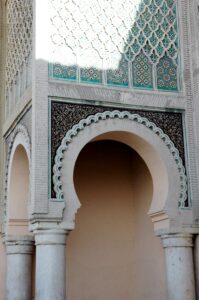
in Meknes, not to be confused with the more famous one in Fes, is a beautiful 14th century Quranic school with excellent carved plaster and cedar wood. Significantly less visited than its Fes equivalent, which means you can often have it largely to yourself.
The souks in Meknes are organized by trade in the traditional Moroccan way, the carpet souk, the metalwork souk, the textile souk and function primarily for local people. Prices are considerably lower than in Marrakech or even Fes. If you want to buy quality Moroccan craft without the aggressive sales environment of the more touristy cities, Meknes is the place to do it.
VOLUBILIS .. ROME IN MOROCCO
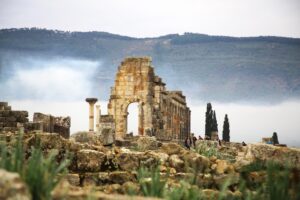
Twenty kilometers north of Meknes, the Roman ruins of Volubilis are among the best-preserved in Africa. Founded in the 3rd century BC and reaching its peak as a Roman provincial capital in the 2nd and 3rd centuries AD, Volubilis was abandoned after the Romans withdrew and slowly covered by earth, which preserved its mosaics extraordinarily well.
The mosaics are the reason to come. Spread across the floors of excavated villas, they depict scenes from Roman mythology, hunting scenes, portraits, many in excellent condition after 1,800 years. The Triumph of Bacchus, the Labors of Hercules, the Desultor mosaic, these are genuine masterpieces of Roman art sitting in the open air of the Moroccan countryside.
The ruins also include a triumphal arch, a basilica, a forum, public baths and the remains of dozens of private houses. The site is large, allow at least two hours, more if you are interested in Roman history.
Grand taxis from Meknes to Volubilis cost around 100-150 MAD for the taxi, negotiate a return trip including waiting time. The site opens at 8am and is best visited in the morning before the heat.
THE FOOD
Meknes has excellent traditional Moroccan food at prices significantly lower than Marrakech or Fes. The restaurants around Place El-Hedim and in the medina streets serve honest tagines, harira and grilled meats at 40-70 MAD for a full meal.
Meknes is known for its wine, the surrounding Meknès-Fès wine region produces most of Morocco’s wine and the local cooperative Caves de Meknès makes wines that are exported across Europe. This is not information most Morocco guidebooks include, but Meknes is one of the few places in Morocco where you can visit a winery and taste locally produced wine. Ask at your accommodation for the current visiting arrangements.
The Thursday and Sunday souks outside the medina walls are large weekly markets serving the surrounding agricultural region, excellent produce, live animals, second-hand goods, an authentic slice of Moroccan rural commercial life.
WHERE TO STAY
Meknes has good riads and guesthouses at the lowest prices of any Imperial City. A clean, comfortable riad with breakfast costs €30-50 per night. There is no premium for being in Meknes, the lack of tourism means prices have not been inflated.
Stay in the medina, within walking distance of Place El-Hedim. The Ville Nouvelle has more conventional hotels but loses the atmosphere entirely.
PRACTICAL INFORMATION
Getting there: Meknes is on the main train line between Casablanca and Fes. Trains from Fes take 45 minutes, from Casablanca about 3 hours. CTM buses from major cities also serve Meknes.
Getting around: Petits taxis within the city. Grand taxis for Volubilis and the surrounding area.
Best time to visit: Spring and autumn are ideal. Summer can be hot but the Imperial City monuments are largely outdoor and best visited early morning. Winter is mild and very quiet.
How long to spend: 1-2 nights is enough for the medina and Imperial City. Add a third night if you want to visit Volubilis properly and explore at a slower pace.
Budget: The cheapest of the Imperial Cities. Riad €30-50/night. Meals 40-70 MAD. Taxis and entrance fees are minimal. Meknes is excellent value in every respect.
MARIA’S HONEST VERDICT
Meknes is my answer when people ask where to go in Morocco if they want to avoid the crowds. It has everything the other Imperial Cities have extraordinary historic monuments, a functioning medina, excellent food, beautiful riads and none of the tourist infrastructure that can make Fes and Marrakech exhausting. The Romans left magnificent ruins twenty minutes away. The sultan who built it employed 30,000 workers on a project that rivaled Versailles. And on a typical Tuesday afternoon you can walk through Bab Mansour, one of the most beautiful gates in the world and have it almost entirely to yourself. That is increasingly rare in Morocco. Go before it changes.