Casablanca has an image problem. Most travelers pass through on their way to Marrakech or Fes, spend a night near the airport, see the Hassan II Mosque and leave thinking they’ve seen it. They haven’t. Casablanca is the most misunderstood city in Morocco, not because it’s hiding extraordinary medieval architecture or dramatic landscapes, but because what it offers is something completely different from the rest of the country and most visitors aren’t looking for it.
Casablanca is Morocco’s economic engine. It’s where business gets done, where the middle class lives, where contemporary Moroccan culture is being invented right now. It has the best international restaurants in the country, a genuine café culture, a coastline that locals actually use and an Art Deco architectural heritage that is slowly being recognized as one of the finest in Africa.
Come with the right expectations and Casablanca will surprise you.
HASSAN II MOSQUE .. THE ONE SIGHT EVERYONE AGREES ON
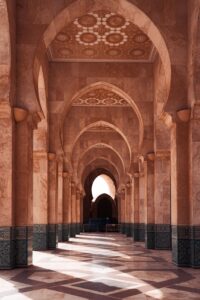
The Hassan II Mosque is the third largest mosque in the world and the only mosque in Morocco open to non-Muslims. It sits on a promontory above the Atlantic, part of the building extends over the sea on a glass floor and the minaret at 210 meters is the tallest religious structure in the world.
The architecture is extraordinary: Moroccan craftsmanship at a scale that is almost incomprehensible. The interior can hold 25,000 worshippers with another 80,000 in the surrounding esplanade. The carved plaster, zellige tilework and cedar woodwork were executed by master craftsmen from across Morocco.
Guided tours run several times daily and are the only way non-Muslims can access the interior. Worth every dirham of the entrance fee. Go early morning for the best light on the exterior and the fewest crowds inside.
THE ART DECO CITY .. WHAT MOST VISITORS MISS
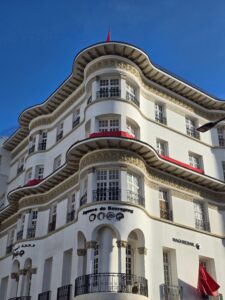
Between the 1920s and 1950s, during the French Protectorate period, Casablanca was built as a showcase modern city. French architects, working in collaboration with Moroccan craftsmen, created a hybrid style that combined Art Deco modernism with traditional Moroccan elements. The result is one of the most distinctive urban architectural heritages in Africa.
The neighborhood to explore is the old Medina and the streets immediately surrounding it, particularly the area around Place Mohammed V, the Boulevard Mohammed V and the streets running toward the port. The buildings are faded, some are crumbling, but the details are extraordinary: ceramic tile facades, ornate ironwork, Moorish arches on modernist buildings, carved stone and painted plaster.
The Palais de Justice on Place Mohammed V is one of the finest examples of the Franco-Moroccan style. The Central Market, the Villa des Arts and the former Hotel Lincoln are all worth seeing.
Guided Art Deco walking tours run from Casa Mémoire, the heritage conservation organization based in the city. Worth booking if architecture interests you.
THE CORNICHE .. CASABLANCA’S WATERFRONT
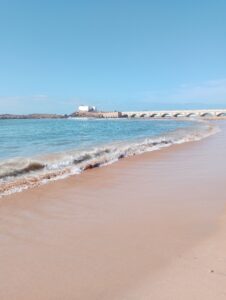
The Corniche is the coastal boulevard that runs south from the Hassan II Mosque through the Ain Diab neighborhood. On weekends it fills with Casablancais, families, couples, teenagers on motorcycles, vendors selling corn and nuts. The beach clubs along the Corniche are where the city’s middle class spends its summers.
The beach itself is not the cleanest in Morocco, the waters near a city of 4 million people have their limitations. But the atmosphere on the Corniche on a summer evening, with the Atlantic breeze and the cafés and restaurants filling up, is genuinely enjoyable and completely local.
Rick’s Café, the recreation of the fictional bar from the film Casablanca, is a tourist attraction that is surprisingly well done. The 1942 Humphrey Bogart film was not shot in Casablanca, it was made entirely in Hollywood, but the café is beautiful and the cocktails are good. Worth a drink if you have a romantic attachment to the film.
THE FOOD SCENE .. THE BEST IN MOROCCO
This is where Casablanca genuinely excels. The city has Morocco’s most sophisticated restaurant scene, not traditional Moroccan food, which you can get better in Fes or Marrakech, but contemporary cooking that draws on Moroccan ingredients and French technique, Japanese influences, Lebanese cuisine and everything in between.
The Gauthier and Racine neighborhoods have the highest concentration of good restaurants. The Central Market area has excellent seafood. The Habous quarter, a planned Moroccan neighborhood built by the French in the 1930s, has good traditional food and excellent patisseries making Moroccan pastries.
For traditional Moroccan food in Casablanca: the restaurants in the old Medina are good and inexpensive. A full meal with tagine costs 40-80 MAD. Avoid the tourist-facing restaurants near the Hassan II Mosque which charge premium prices for average food.
The seafood in Casablanca is excellent, the city’s position on the Atlantic means fresh fish is available daily. The fish restaurants along the port and Corniche are generally reliable.
THE HABOUS QUARTER
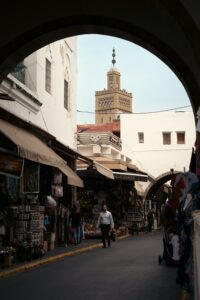
The Habous, built in the 1930s as a planned neighborhood for the growing Moroccan urban population, is one of the most interesting urban planning experiments of the colonial period. French architects designed an entire neighborhood using traditional Moroccan forms, arcade streets, interior courtyards, a market organized around a central mosque, but laid out with modern urban planning principles.
The result is a neighborhood that feels genuinely Moroccan but is oddly legible to Western visitors, the streets make sense, the scale is human, the architecture is beautiful. The patisseries in the Habous make the best Moroccan pastries in the city. The bookshops have an excellent selection of books about Morocco in French and Arabic.
PRACTICAL INFORMATION
Getting there: Mohammed V International Airport is 30km from the city center. The train runs directly from the airport to Casa Port and Casa Voyageurs stations in about 45 minutes and costs around 45 MAD. Much cheaper and faster than a taxi.
Getting around: Casablanca has a tram system that covers the main axis of the city. Petits taxis for everything else. The city is large, walking between neighborhoods is not practical.
Best time to visit: Casablanca has a mild Atlantic climate year-round. Summer is warm but not as extreme as inland cities. Winter is mild. Spring and autumn are pleasant.
How long to spend: 1-2 nights is enough for most visitors. The city rewards a longer stay if you’re interested in architecture, food and contemporary Moroccan urban life.
Budget: More expensive than other Moroccan cities for accommodation. A good hotel costs €60-120 per night. Food ranges from very cheap in local restaurants to expensive in the international dining scene.
MARIA’S HONEST VERDICT
Casablanca is not the Morocco most visitors come looking for. There is no ancient medina to get lost in, no dramatic desert landscape, no UNESCO-listed historic district. What there is instead is a real, functioning, complex modern African city, ambitious, contradictory, occasionally chaotic and more interesting than most visitors expect. If you come looking for the Morocco of the guidebooks, you will be disappointed. If you come curious about what Morocco actually is in 2026, Casablanca will be one of the most interesting stops on your trip.