Rabat is Morocco’s capital and its best-kept secret. While tourists flood Marrakech and Fes, Rabat sits quietly on the Atlantic coast doing what capitals do governing, educating, diplomating largely unbothered by the travel industry. This is precisely what makes it worth visiting.
Rabat has a UNESCO World Heritage medina, a 12th century unfinished minaret that is one of the most impressive monuments in the Islamic world, a royal palace, Roman ruins within city limits and one of the most pleasant city atmospheres in Morocco. It also has almost no tourist hustle. Nobody in Rabat is trying to sell you a carpet or guide you to a tannery. People go about their lives and largely leave visitors alone. After Marrakech, this feels extraordinary.
THE HASSAN TOWER AND MAUSOLEUM OF MOHAMMED V
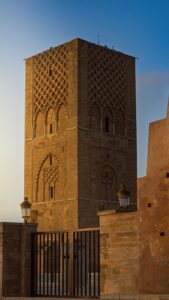
The Hassan Tower is the minaret of an unfinished 12th century mosque construction stopped when Sultan Yacoub al-Mansour died in 1199, leaving a tower that reaches 44 meters of a planned 86. What remains is one of the most beautiful examples of Almohad architecture in existence, standing in a field of broken columns that were to support the mosque roof.
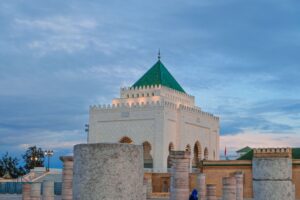
Directly opposite stands the Mausoleum of Mohammed V, completed in 1971 to house the tomb of Morocco’s first post-independence king and his two sons, Hassan II and Prince Abdallah. The mausoleum is open to non-Muslims and is one of the finest examples of contemporary Moroccan craftsmanship marble floors, carved plaster ceilings, painted cedar wood and royal guards in traditional dress standing motionless at the entrance.
The complex is free to visit and genuinely moving. Go in the morning when the light on the Hassan Tower is best.
THE KASBAH DES OUDAIAS
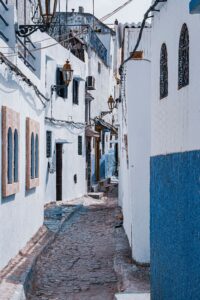
The Kasbah des Oudaias sits on a promontory above the mouth of the Bou Regreg river, looking out over the Atlantic and across to the city of Salé. Founded in the 12th century as a military installation, it became a residential quarter and has remained one ever since.
The streets inside the kasbah are blue and white, predating Chefchaouen’s famous color scheme by centuries and considerably less visited. The Andalusian Garden inside the kasbah walls, planted in the 17th century style, is one of the most peaceful spots in any Moroccan city. The café at the garden entrance has the best view in Rabat.
The beach below the kasbah, accessible by a path down the cliff, is used by local surfers and families on weekends. The Atlantic here is cold and the waves are strong.
THE MEDINA
The Rabat medina is smaller and quieter than Fes or Marrakech and functions primarily for local people rather than tourists. This makes it one of the most pleasant medinas in Morocco to walk through you can browse without being approached, sit in a café without being hustled and get a genuine sense of everyday Moroccan urban life.
The main commercial street, Rue Souika, runs through the heart of the medina and has everything from fabric shops to spice vendors to electronics dealers. The textile souk near the Grand Mosque has good quality Moroccan fabric at honest prices.
The Mellah, the historic Jewish quarter is to the south of the medina. Less well preserved than the Mellah in Fes or Marrakech, but with some beautiful old buildings and a functioning synagogue.
CHELLAH .. RUINS INSIDE THE CITY

On the southern edge of Rabat, the Chellah is one of the most atmospheric sites in Morocco, a walled necropolis containing the ruins of a Roman city and a 14th century Merenid sanctuary, now inhabited by hundreds of storks and colonies of cats.
The Romans built a city here called Sala Colonia. After the Roman withdrawal it was abandoned and in the 14th century the Merenid sultan chose the site for a royal necropolis, building a mosque, a mausoleum and a zawiya over and around the Roman ruins. The result is an extraordinary layering of civilizations.
The storks nest on the minaret and the ruined walls from January to June, the combination of medieval Islamic ruins, Roman columns and enormous nesting storks is unlike anything else in Morocco. Go in the late afternoon when the light is golden and the storks are active.
THE VILLE NOUVELLE AND CAFÉ CULTURE
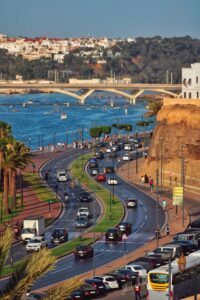
Rabat’s French-built new town is one of the most pleasant in Morocco, wide boulevards, good restaurants, proper coffee shops, a functioning tram system. Avenue Mohammed V is the main commercial artery, lined with cafés and shops that serve a genuinely middle-class Moroccan clientele.
The café culture in Rabat is more sophisticated than in other Moroccan cities, the presence of government ministries, embassies and universities means the city has a large educated professional population who take their coffee seriously. There are several excellent specialty coffee shops in the Agdal and Hassan neighborhoods.
THE FOOD
Rabat has good traditional Moroccan food and a growing contemporary restaurant scene driven by the diplomatic and government community. The medina has honest tagine restaurants at 40-80 MAD for a full meal. The Ville Nouvelle has everything from French bistros to Japanese restaurants to excellent Lebanese food.
The fish in Rabat is excellent, the Atlantic location means fresh seafood daily. The restaurants along the Corniche and near the port serve good grilled fish at reasonable prices.
PRACTICAL INFORMATION
Getting there: Rabat Salé Airport has some international connections but most visitors arrive by train from Casablanca, 45 minutes, runs frequently, costs around 50 MAD. From Marrakech by train takes about 4 hours.
Getting around: Rabat has a tram system covering the main axis of the city. Petits taxis for everything else. The medina and Hassan Tower area are walkable from each other.
Best time to visit: Year-round, the Atlantic climate keeps temperatures mild. Summer is warm but not extreme. Winter is mild and green.
How long to spend: 1-2 nights. Enough to see the main monuments and get a feel for the city. Rabat works well as a stop between Casablanca and Fes.
Budget: Similar to Casablanca, more expensive than Fes or Meknes for accommodation. Good hotel €60-100/night. Food is reasonably priced in local restaurants.
MARIA’S HONEST VERDICT
Rabat is the Morocco that Moroccans actually live in functional, educated, relatively relaxed, proud of its history without being consumed by it. The monuments are genuinely extraordinary and genuinely uncrowded. The city atmosphere is the most pleasant of any large Moroccan city. If your Morocco itinerary currently goes Marrakech-Fes-Chefchaouen, consider adding Rabat. It will give you a completely different and completely necessary perspective on what this country actually is.